Dunlop vs Talalay Latex: What Is the Difference?
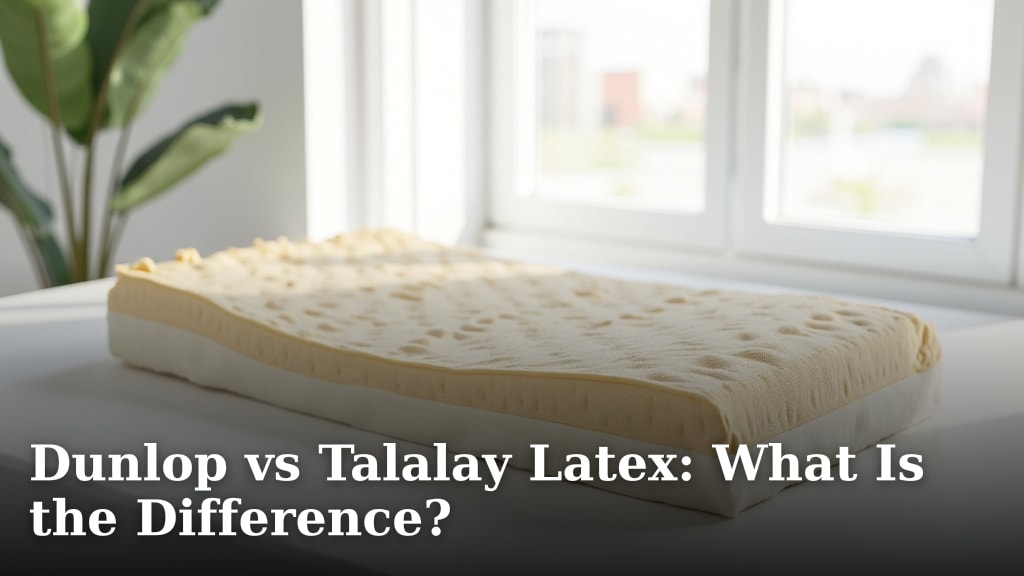
The main difference between Dunlop and Talalay latex is how they are made, which affects their feel and durability. Dunlop latex is denser and firmer, made with a single pour and baked, while Talalay latex is softer and bouncier, using a more complex vacuum process.
You’re probably wondering which one is right for your next mattress or topper, right? We get it. Both types of latex offer amazing comfort and support, but their unique production methods give them distinct qualities. Understanding these differences can really help you choose the best latex for your sleep needs.
- Dunlop is denser and firmer.
- Talalay is softer and bouncier.
- Manufacturing processes differ significantly.
- Both are durable, but Dunlop often lasts longer.
- Your preference for feel will guide your choice.
Let’s walk through exactly what makes each type of latex unique, so you can make an informed decision for a great night’s sleep.
Understanding Dunlop and Talalay Latex Production
The core differences between Dunlop and Talalay latex come from their unique manufacturing journeys. Think of it like baking two different cakes; while both use similar ingredients, the steps and temperatures create vastly different textures.
Both types start with natural latex sap from rubber trees. But after that initial collection, their paths diverge quite a bit. These distinct processes are what give each latex its signature feel and performance.
The Dunlop Process: Simplicity and Density
The Dunlop method is the older, more traditional way to make latex. It’s a simpler, more energy-efficient process. Imagine it as a straightforward pour and bake.
First, liquid latex sap is whipped into a froth. This adds air, making it softer than raw liquid. Then, it’s poured into a mold in a single, continuous layer. The mold gets completely filled.
Next, the mold goes into a vulcanization oven. This bakes the latex, turning it from a liquid foam into a solid, elastic material. During this process, some of the denser latex particles settle to the bottom. This settling creates a subtle gradient in the finished product.
- Latex sap is frothed.
- Poured into a mold in one go.
- Baked (vulcanized) to solidify.
- Results in a denser, firmer feel.
Because of this settling, Dunlop latex can sometimes feel a bit firmer on one side than the other, though this difference is often minimal in high-quality products. It’s naturally robust and tends to be more durable due to its higher density.
The Talalay Process: A More Complex Approach
The Talalay method is a more modern and intricate manufacturing process. It involves a few extra steps, giving it a distinct airy and springy feel. It’s like freezing a soufflé before baking to keep it extra light.
Here, the liquid latex sap is also whipped into a froth. However, it’s only partially filled into the mold. The mold is then sealed, and air is vacuumed out. This vacuum expands the latex foam to fill the entire mold, creating an open-cell structure.
After the vacuum step, the mold is flash-frozen. This freezing locks the air cells in place and prevents the latex particles from settling. Finally, carbon dioxide gas is injected, and the latex is baked (vulcanized).
- Latex sap is frothed.
- Partially fills the mold.
- Vacuum expands the foam.
- Flash-frozen to stabilize cells.
- Baked (vulcanized).
- Results in a lighter, bouncier feel.
This freezing step is key. It ensures the latex foam maintains a consistent density throughout, from top to bottom. That’s why Talalay latex is known for its uniform feel and consistent support.
Dunlop vs. Talalay: Comparing Feel and Performance
Now that you know how they’re made, let’s talk about what that means for you. How will these differences actually feel when you lie down?
The manufacturing process directly impacts the density, resilience, and overall feel of each latex type. This is where your personal preferences really come into play.
Feel and Firmness: What to Expect
When you press into Dunlop latex, you’ll notice it feels denser and more supportive. It has a robust, solid feel. It doesn’t compress as easily, offering a firmer surface that sits higher on the 1-to-10 firmness scale. Think of it as a sturdy foundation.
Talalay latex, on the other hand, feels softer and more buoyant. It has a springier, more responsive feel. When you press down, it quickly bounces back. Many describe it as feeling lighter and airier.
Durability and Longevity
Both Dunlop and Talalay latex are known for being incredibly durable, far outlasting traditional foam mattresses. However, there are some subtle differences.
Dunlop latex, being denser, generally has a slight edge in terms of raw durability and lifespan. Its more compact structure often means it can withstand more wear and tear over many years. We found that Dunlop often lasts 15-20 years or more with proper care.
Talalay latex is also very durable, but its lighter, more open cell structure can sometimes make it marginally less resistant to deep compression over extremely long periods. Still, you can expect a high-quality Talalay mattress to last a solid 10-15 years, which is still excellent.
Support and Pressure Relief
When it comes to support, both types excel. They contour to your body naturally, helping to align your spine. This is a big reason why latex is so popular for pain relief.
Dunlop latex provides a more “on-the-mattress” feel. It offers firm, consistent support that prevents excessive sinking. It’s great if you need robust push-back, especially for back and stomach sleepers.
Talalay latex offers a more “in-the-mattress” feel due to its softer top layers. It cradles the body more closely, offering excellent pressure relief for shoulders, hips, and other pressure points, much like a soft, plush mattress. This makes it a favorite for side sleepers.
Temperature Regulation
Latex, in general, sleeps cooler than memory foam, which behaves differently from poly foam, because it doesn’t trap heat as much. But there’s a slight difference between the two types.
Talalay latex, with its open-cell structure from the vacuum and freezing process, tends to be more breathable. The interconnected cells allow for better airflow, dissipating heat more effectively. This can be a big plus if you tend to sleep hot.
Dunlop latex is also breathable, but its denser composition means it might not have the same level of airflow as Talalay. It still performs better than many other mattress materials for coolness, but Talalay often wins in this specific category.
Cost and Environmental Impact
When you’re making a significant purchase like a mattress, cost is always a factor. And if you’re eco-conscious, you’ll want to consider the environmental footprint.
Price Point Comparison
Generally, Talalay latex products tend to be more expensive than Dunlop. This isn’t because one is “better,” but because the Talalay manufacturing process is more complex and involves more steps, including the vacuum chamber and flash-freezing.
The additional machinery and energy required for the Talalay process translate to higher production costs. Dunlop’s simpler method makes it a bit more budget-friendly while still offering fantastic quality and durability.
Environmental Considerations
Both Dunlop and Talalay latex are more environmentally friendly than synthetic foams, as they originate from a renewable resource: rubber tree sap. However, there are nuances.
The Dunlop process is often considered more eco-friendly because it uses fewer steps and less energy. There’s also less waste produced. It’s a very pure and natural process, often resulting in 100% natural latex products.
The Talalay process uses more energy and chemicals (like CO2 for injection). While many Talalay manufacturers strive for sustainability, the process itself has a slightly larger footprint. You can find “natural Talalay” which is made without synthetic fillers, but some Talalay can be a blend of natural and synthetic latex. Always check for certifications like Oeko-Tex or GOLS to ensure you’re getting a truly healthy product.
Which Latex is Right for You? A Quick Guide
So, after all this information, how do you decide? It really boils down to your personal preferences and needs. There’s no single “best” latex; there’s only the best latex for you.
| Feature | Dunlop Latex | Talalay Latex |
|---|---|---|
| Feel | Denser, firmer, more supportive | Softer, bouncier, more resilient |
| Support | “On-the-mattress” feel, robust push-back | “In-the-mattress” feel, pressure-relieving cradle |
| Durability | Generally longer-lasting (15-20+ years) | Excellent durability (10-15 years) |
| Breathability | Good, but slightly less than Talalay | Excellent, very breathable |
| Cost | Less expensive to moderately priced | More expensive due to complex process |
| Eco-Friendliness | More energy-efficient, often 100% natural | More complex process, can be natural or blended |
Consider Your Sleeping Position
Your preferred sleeping position is a big clue:
- If you’re a side sleeper, the extra pressure relief and cushioning of Talalay often feels amazing. It helps relieve pressure on your shoulders and hips.
- If you’re a back or stomach sleeper, the firmer support of Dunlop can be ideal. It keeps your spine aligned without too much sinkage.
Your Personal Comfort Preferences
Think about what you like in a mattress. Do you prefer a bed that feels like a firm hug, or one that feels like you’re floating on a cloud? Many experts say personal preference is king (Cleveland Clinic).
Ask yourself:
- Do you love a firm, solid mattress?
- Do you prefer a soft, plush feel?
- Is bounciness important to you?
- Do you tend to overheat at night?
- Is a lower price point a priority?
- Is maximum eco-friendliness crucial?
Answering these questions will guide you towards your ideal latex type. It’s like choosing between a firm, supportive running shoe and a soft, bouncy one – both are great, but for different strides!
Conclusion
Choosing between Dunlop and Talalay latex ultimately comes down to your personal sleep preferences and priorities. If you love a firmer, denser feel with maximum durability and a slightly lower price point, Dunlop is likely your match. If you prefer a softer, bouncier, more breathable feel with excellent pressure relief, Talalay will probably win you over. Both offer superior comfort and support. Consider your sleeping position, desired firmness, and budget, and if firmness is the sticking point our guide to picking firmness without guessing can help. Trust your gut feel – you’re well-equipped now to pick the latex that will give you the best night’s sleep.
Frequently Asked Questions
Can Dunlop and Talalay latex be combined in one mattress?
Yes, many high-quality latex mattresses use layers of both Dunlop and Talalay. This allows manufacturers to create a customized feel. Often, a firmer Dunlop layer forms the supportive core, while a softer Talalay layer provides plush comfort on top.
Is one type of latex better for allergies or sensitivities?
Both Dunlop and Talalay latex are naturally hypoallergenic, resistant to dust mites, mold, and mildew. If you have severe allergies, look for products certified 100% natural latex (like GOLS for Dunlop or Oeko-Tex for Talalay) to ensure no synthetic fillers or harsh chemicals are present.
How can I tell if a mattress is Dunlop or Talalay if it doesn’t specify?
If the product description doesn’t explicitly state the type, look for keywords. “Dense,” “firm support,” and “long-lasting” often point to Dunlop. “Bouncy,” “plush,” “airy,” and “pressure-relieving” often describe Talalay. Don’t hesitate to contact the retailer directly to ask for clarification.
Does the country of origin affect the quality of Dunlop or Talalay latex?
Not necessarily. The quality of latex primarily depends on the manufacturing standards and the purity of the sap, not just the country. However, some regions like Sri Lanka and Thailand are known for high-quality rubber tree sap. Always check for certifications rather than just origin.
Can I use a Dunlop or Talalay latex topper on any type of mattress?
Yes, you can generally use a latex topper on most types of mattresses, including innerspring, foam, or even older latex mattresses. A latex topper is a great way to adjust the feel of your current bed without buying a whole new mattress. Just ensure the topper thickness and firmness complement your existing mattress and desired comfort.