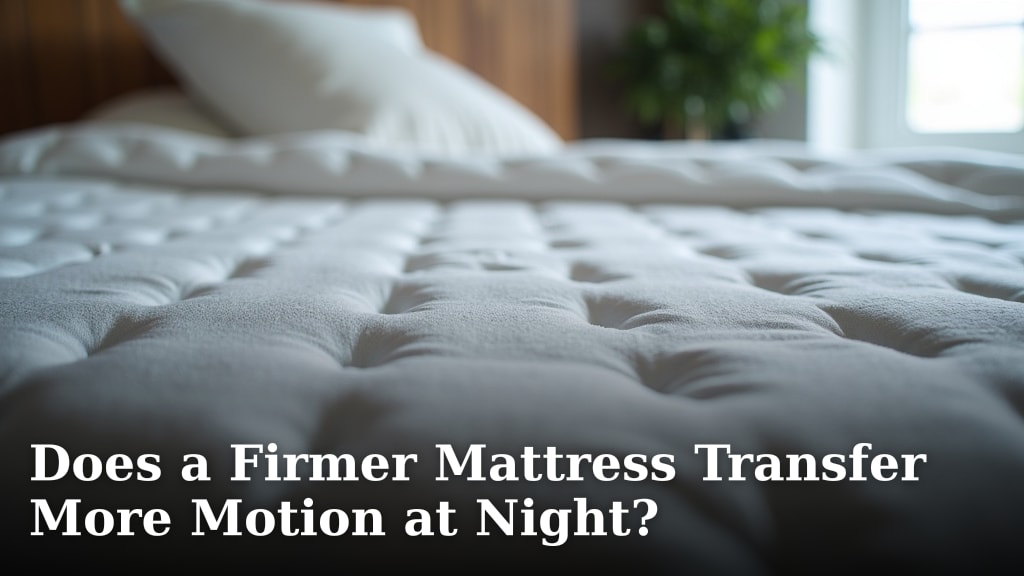
Does a Firmer Mattress Transfer More Motion at Night?
Yes, a firmer mattress generally transfers more motion at night compared to softer options. This is because firmer surfaces offer less cushioning. They tend to bounce back more readily when pressure is applied. So, if your partner tosses and turns, you might feel it more distinctly on a firmer bed. We found that the responsiveness of the materials plays a big role here.
Understanding mattress motion transfer is key for peaceful sleep, especially for couples. While firmness is a major factor, the type of mattress material also matters greatly. Some materials are naturally better at absorbing movement. Others, like traditional innerspring systems, can amplify every little shift. We looked into how different mattress constructions affect sleep disruption.
- Firmer mattresses often transfer more motion.
- Softer mattresses tend to absorb movement better.
- Mattress materials (like foam vs. springs) significantly impact motion isolation.
- Motion transfer can disrupt sleep for partners.
Let’s dive deeper into why this happens and what you can do to find a mattress that keeps both of you sleeping soundly through the night.
It’s a classic bedroom dilemma: you’re sleeping soundly, but your partner’s every move sends ripples through the mattress, jolting you awake. You might wonder if your mattress’s firmness plays a role in this nightly disturbance. Let’s explore how firmness affects motion transfer and what that means for your sleep.
How Mattress Firmness Affects Motion Transfer
When we talk about motion transfer, we’re really talking about motion isolation. It’s how well a mattress can absorb or “contain” movement. This means when one person moves, the other person doesn’t feel it. A firmer mattress typically doesn’t do as well with this as a softer one. Think of it like this: a firm surface is less forgiving.
When you press down on a firm mattress, it pushes back more. It doesn’t sink in much to cushion the pressure. This lack of give means that when your partner shifts their weight, the energy of that movement travels more freely across the surface. It’s like a tightly stretched trampoline; a small bounce on one side makes the whole thing wobble. We found that the less a mattress compresses, the more likely it is to transmit motion.
The Science Behind Firmness and Motion
The key here is compression and rebound. Softer mattresses allow for more compression. Your body weight sinks into them, creating a sort of “hug.” This hug helps to absorb the energy of movement. Instead of bouncing back immediately, the mattress material takes some of that energy and dampens it.
Firmer mattresses, conversely, have less give. They might feel supportive, which is great for spinal alignment. But that same lack of deep compression means they rebound more quickly. Any force applied to one side is less likely to be absorbed. It’s more likely to be passed along. Many sleep experts point to this direct relationship between minimal compression and increased motion transfer. It’s a fundamental physics principle at play.
What “Firmness” Really Means for Motion
When you choose a firmer mattress, you’re often choosing a surface that feels more solid. This can be excellent for people who need more support or who sleep on their stomachs. However, this solidity means the mattress doesn’t contour as deeply to your body. It doesn’t mold around you, so there’s less surface area in contact to absorb pressure.
Imagine trying to catch a bouncy ball. If you hold your hand flat and stiff, the ball will likely bounce off. But if you cup your hand and let it absorb some of the impact, the ball’s energy is reduced. A firmer mattress acts more like the stiff hand. It doesn’t “cup” your body’s movements effectively. This is why you might feel your partner’s tossing and turning more acutely.
Understanding Different Mattress Materials and Motion Transfer
Firmness isn’t the only factor. The materials used in a mattress play a huge role in how well it handles motion. Some materials are naturally better at absorbing movement than others. This is often tied to their density and structure. We found that the right material can make a big difference, even on a firmer feel.
Memory Foam: The Motion Isolation Champion?
Memory foam is often celebrated for its ability to isolate motion. When you press into memory foam, it slowly reshapes itself. This slow response time is fantastic for absorbing movement. If your partner rolls over, the foam slowly compresses and then slowly rebounds. This process is much less likely to send vibrations across the bed. Many users report that memory foam mattresses feel like they “swallow up” motion. This is why it’s a popular choice for couples.
Even a firmer memory foam mattress will usually outperform a spring mattress in motion isolation. The dense structure of memory foam is key. It doesn’t have the airy spaces or interconnected coils found in other types of mattresses. This makes it a natural dampener. We found that even firmer density memory foams offer good motion isolation.
Latex: A Balanced Approach
Latex mattresses offer a unique feel. They can range from soft to firm. Natural latex, in particular, has a responsive bounce. While it offers good contouring, it also springs back quickly. This means it’s not quite as good at motion isolation as memory foam.
However, latex is generally better than traditional innerspring mattresses. It doesn’t have the same interconnected coil system that can transfer movement easily. If you’re considering a latex mattress, the firmness level will matter. A firmer latex might transfer more motion than a softer one. Still, its natural density helps it absorb some movement. We found that some modern latex constructions are engineered to improve motion isolation.
Innerspring Mattresses: The Motion Transfer Culprit?
Traditional innerspring mattresses often use a system of interconnected coils. Think of a “Bonnell” coil system. When one coil moves, it pulls on its neighbors. This creates a domino effect. Any movement on one side of the bed is quickly telegraphed to the other side. These mattresses tend to have a bouncier feel, which many people like, but it comes at the cost of motion isolation.
Pocketed coils, found in many modern innerspring and hybrid mattresses, are a different story. Each coil is individually wrapped in fabric. This allows them to move independently. While better than interconnected coils, they can still transfer more motion than foam or latex. This is because they still have that springy, reactive quality. We found that pocketed coils are a significant improvement but may not completely eliminate motion transfer for very light sleepers.
Hybrid Mattresses: A Mix of Pros and Cons
Hybrid mattresses combine an innerspring base with comfort layers of foam or latex. Their motion transfer capabilities depend heavily on the specific design. A hybrid with pocketed coils and a thick memory foam top layer might offer excellent motion isolation. However, a hybrid with a firmer latex top and a less robust coil system might transfer more motion.
The goal with a hybrid is often to get the best of both worlds: support from the coils and comfort/motion isolation from the foam or latex. If motion transfer is a primary concern, look for hybrids with a substantial layer of memory foam or a very high pocket count for the coils. We found that the thickness and density of the comfort layers are critical for hybrids.
Assessing Motion Transfer for Your Needs
So, how do you figure out what will work best for you and your partner? It’s about understanding your sleep habits and priorities. If you’re a very light sleeper, or if your partner is a restless sleeper, motion isolation becomes a bigger deal.
Consider Your Sleeping Partner
If you share your bed, you’re likely more sensitive to motion transfer. Light sleepers often wake up easily. If your partner moves a lot in their sleep, you’ll feel it more on a mattress that doesn’t isolate motion well. This can lead to fragmented sleep for both of you.
Many couples find that memory foam or latex mattresses are a good compromise. They offer comfort for both partners. Even a firmer version can work if it has good motion isolation properties. We found that many couples prioritize motion isolation and are willing to accept a slightly softer feel for better sleep quality.
What About Back Sleepers and Stomach Sleepers?
If you primarily sleep on your back or stomach, you might prefer a firmer mattress. This is because it keeps your spine aligned. You may not be as sensitive to motion transfer as a side sleeper, as your weight is distributed more evenly. However, if your partner’s movements are significant, you’ll still feel them.
A firmer mattress with good pocketed coils and a supportive foam top layer could be a good option. It offers the firmness you need while still providing some degree of motion absorption. We found that for these sleepers, firmness is often the priority, but motion transfer can still be a concern.
Side Sleepers and Motion Sensitivity
Side sleepers often need a softer mattress. This allows their hips and shoulders to sink in, relieving pressure points. Softer mattresses, by their nature, tend to absorb motion better. You might find that a softer mattress naturally isolates motion well. This is a win-win if you’re a side sleeper sensitive to disturbances.
However, if you prefer a firmer mattress but are a side sleeper, you’ll need to be more selective. Look for advanced foam technologies or high-quality pocketed coils. We found that side sleepers are often more attuned to pressure points and motion transfer, making material choice very important.
When is Motion Transfer a Dealbreaker?
Motion transfer becomes a dealbreaker when it consistently disrupts your sleep. If you wake up multiple times a night due to your partner’s movements, it’s a problem. This lack of restful sleep can impact your mood, energy levels, and overall health. Poor sleep quality is something many health organizations, like the CDC, highlight as a major concern.
Consider a mattress trial. Most online mattress companies offer a trial period. This lets you test the mattress in your own home. It’s the best way to see how it performs for both of you. We found that a generous trial period is crucial for making the right decision.
Making the Right Choice for Undisturbed Sleep
Choosing a mattress involves balancing firmness, comfort, and motion isolation. A firmer mattress *can* transfer more motion, but it doesn’t always have to. The materials and construction make a huge difference.
Consider these key points:
- Prioritize materials: Memory foam and high-density latex generally offer superior motion isolation.
- Coil type matters: Pocketed coils are better than interconnected coils for reducing motion transfer.
- Firmness isn’t everything: A firmer mattress can still isolate motion if designed with the right materials.
- Hybrid designs vary: Look for thick comfort layers on hybrid models.
- Test it out: Use mattress trials to ensure it works for you and your partner.
Conclusion
So, the answer to whether a firmer mattress transfers more motion isn’t a simple yes or no. While firmer surfaces *tend* to bounce back more, leading to increased motion transfer, it’s not the whole story. Your mattress’s materials and construction play a massive role in how well it isolates movement. Memory foam and latex generally excel, even in firmer versions. If you and your partner are sensitive to movement, prioritize motion isolation when shopping. Your best bet is to utilize mattress trial periods to test a bed’s performance in your own home before committing to your next mattress.
Frequently Asked Questions
Will a firm mattress wake me up if my partner moves?
A firmer mattress might make you more aware of your partner’s movements. Because it compresses less, the energy from their shifts can travel more easily across the bed. This means you might feel those disturbances more acutely than on a softer mattress.
Can a firm mattress still offer good motion isolation?
Yes, it absolutely can! The materials used are key. A firmer mattress made with dense memory foam or advanced pocketed coils can still absorb a lot of movement. It’s about how the mattress is engineered, not just its firmness level.
What mattress material is best for couples worried about motion transfer?
Memory foam is often the top choice for couples because it excels at absorbing movement. Latex also performs well, offering a good balance of responsiveness and motion isolation. These materials conform to the body, dampening vibrations.
Is a hybrid mattress good for motion isolation if it feels firm?
It depends on the hybrid’s design. If a firm hybrid has thick comfort layers of memory foam on top of pocketed coils, it can offer excellent motion isolation. However, if the comfort layer is thin or made of less dense material, it might transfer more motion.
How can I test a mattress for motion transfer at home?
During your mattress trial, have your partner move around on the bed while you lie down. Try rolling over, getting up and down, and shifting positions. See if you feel any significant movement transfer. This is the best way to know for sure.