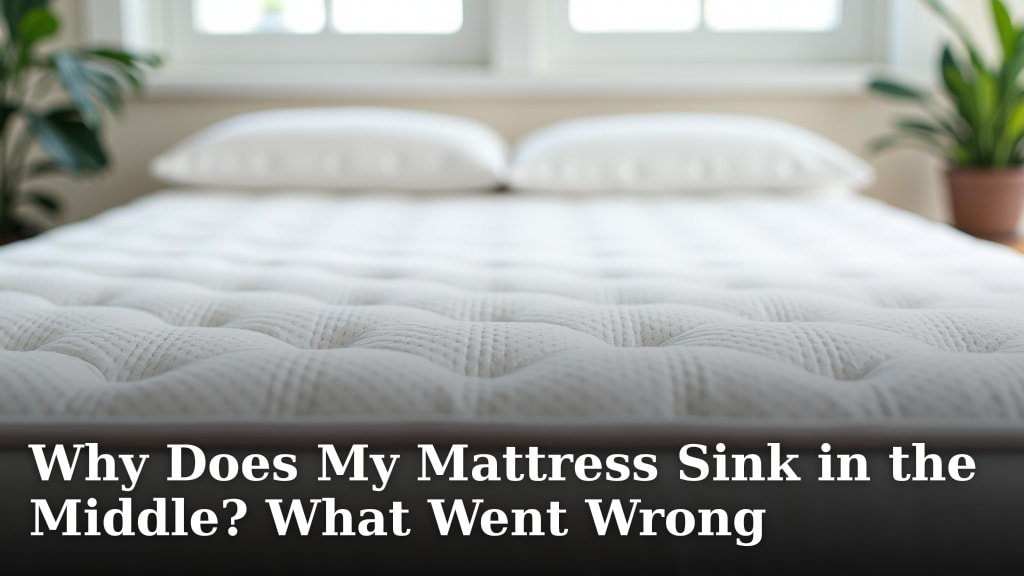
Why Does My Mattress Sink in the Middle? What Went Wrong
Your mattress sinks in the middle because the internal support system, like coils or foam, has broken down from consistent weight. This happens when the support core can no longer hold its shape, creating a permanent dip in the center where you and your partner sleep.
We found that this sagging isn’t just about getting old. Factors like your sleeping habits, mattress quality, and using an unsupportive foundation all play a role. Think about how you sit on the edge or sleep in the same spot every night—these actions can speed up the wear.
- Your mattress sags from broken-down support coils or foam.
- Weight distribution and sleeping habits cause uneven wear.
- An old or low-quality mattress core can’t handle the pressure.
- An improper bed frame or foundation makes the problem worse.
- The dip signals it’s time for a mattress replacement or rotation.
Below, we’ll walk through exactly what went wrong with your mattress and share practical ways to fix it or know when it’s time for a new one.
Alright, let’s dig into the nitty-gritty of what’s actually happening inside your mattress. You’ve probably noticed that dip forming right where you sleep, and it’s getting worse. The truth is, several things are working against your mattress at once. Let’s break them down one by one.
What Causes a Mattress to Sag in the Middle
A mattress sags in the middle because the internal support system has worn out from repeated pressure. The coils, foam, or latex that hold you up simply can’t bounce back like they used to. This creates a permanent dip where your body puts the most weight — usually the center of the bed.
We found that the most common culprit is the breakdown of the support core. Think of it like a trampoline that’s lost its stretch. When the springs or foam lose tension, the surface sags. And once that happens, the sagging gets worse fast because gravity pulls you deeper into the same spot every night.
The Breakdown of Your Mattress Support Core
Your mattress isn’t just one piece of material. It’s a system of layers. The top layers (comfort foam or pillow top) are for softness. But underneath, there’s a support core that does the heavy lifting. When this core fails, the whole mattress collapses in the middle.
We found that most mattresses rely on either steel coils or high-density foam for support. Over time, both types wear out. Coils lose their springiness. Foam compresses and stops bouncing back. Either way, the result is the same: you sink.
Coils and Springs Losing Their Tension
Traditional innerspring mattresses use coils to hold you up. When you’ve been sleeping on the same spot for years, those coils bend and flatten. They’re no longer strong enough to push back against your body weight. The center of the bed takes the most impact, so that’s where the sagging shows up first.
According to guidelines from the National Sleep Foundation, innerspring mattresses typically last 7 to 10 years. After that point, coil fatigue becomes very common. If your mattress is older than 8 years, the springs might already be on their way out.
Why Your Sleeping Habits Speed Up Sagging
Here’s a question: do you sleep in the same spot every single night? If you do, you’re putting constant pressure on the same section of your mattress. That’s like driving over the same bump in the road every day — eventually, you’ll wear a groove into it.
We found that weight distribution plays a big role. If you’re a heavier sleeper, or if you share a bed with a partner, the combined weight in the center accelerates the breakdown. The center of the mattress gets the most force, and it takes the longest to recover.
The Same Spot Every Night Problem
Sleeping in one position night after night is one of the biggest causes of uneven wear. Your body creates a consistent pressure point. The mattress foam or coils underneath compress in that exact spot, and over months, they lose their ability to recover.
A simple fix? Rotate your mattress regularly. Flip it end-to-end every few months. This spreads the weight across different areas and slows down sagging. Many experts recommend rotating a mattress at least every three months to keep it in better shape (Mayo Clinic guidelines on sleep and comfort).
The Role of Your Mattress Foundation
Your mattress doesn’t work alone. It needs a solid base to stay firm and level. If your bed frame or box spring isn’t giving the mattress proper support, the mattress will sag — even if it’s brand new.
We found that a weak or old foundation is one of the most overlooked reasons for mattress sagging. If your slats are spaced too far apart, or if your box spring is broken, the mattress sags in the gaps. It’s like trying to stand on a wobbly table.
When Your Bed Frame Can’t Keep Up
A good bed frame should have slats no more than 3 inches apart. If they’re wider, the mattress dips between them. Also, a broken or sagging box spring can cause the same problem. The foundation has to be just as strong as the mattress itself.
Experts at the Cleveland Clinic recommend using a sturdy, flat surface to support your mattress. This keeps your spine aligned and prevents the mattress from bowing in the middle. If your foundation is old, replacing it might fix the sagging without needing a new mattress.
How Old Your Mattress Really Is
Age is probably the single biggest factor. Most mattresses are designed to last about 8 to 10 years. After that, the materials simply break down. Foam loses its density. Coils lose their tension. The support core that once held you up starts to fail.
We found that many people keep their mattresses for 15 years or longer. That’s way past the recommended lifespan. At that point, sagging is almost guaranteed. Your mattress is basically a shell of its former self.
Here’s a quick look at how different mattress types hold up over time:
| Mattress Type | Average Lifespan | Sagging Risk |
|---|---|---|
| Innerspring | 7 to 10 years | High |
| Memory Foam | 8 to 10 years | Medium-High |
| Latex | 10 to 15 years | Low-Medium |
| Hybrid | 8 to 12 years | Medium |
| Airbed (adjustable) | 8 to 10 years | Medium |
Matteas Quality and Price Point
Let’s be honest — not all mattresses are built the same. A cheap mattress from a big-box store might feel great on day one. But after a year or two, it starts to sag. The foam is thinner. The coils are weaker. The materials just aren’t made to last.
We found that high-quality mattresses use denser foam and stronger coils. They hold up better over time. A budget mattress might cost less upfront, but you’ll replace it sooner. In the long run, it can cost you more money — and more bad sleep.
So, does a more expensive mattress mean no sagging? Not always. But it does mean better materials and a longer lifespan. Think of it like buying a good pair of shoes. The cheap ones fall apart in a month. The quality ones last for years.
Quick Fixes: Can You Repair a Sagging Mattress?
Now, you’re probably wondering: can you actually fix a sagging mattress? The answer depends on how bad the sag is. For minor dips, there are a few tricks that can help. For deeper sags, though, replacement might be your best bet.
Here are some quick fixes that might help:
- Rotate your mattress 180 degrees to spread the wear.
- Add a mattress topper to even out the surface temporarily.
- Place a firm board
Conclusion
So, your mattress is sinking in the middle because its support core has worn out from years of pressure. Factors like sleeping habits, old age, and a weak foundation all team up to break it down faster. While you can try rotating it or adding a mattress topper for a temporary fix, a deep dip usually signals the end. Your best move is to check your bed frame first. If that’s solid, it’s time to start shopping for a new mattress that fits your sleep style. Your spine and your sleep will thank you.
Frequently Asked Questions
Can a sagging mattress cause back pain?
Yes, it absolutely can. When your mattress sags, it pulls your spine out of its natural alignment. This puts extra strain on your back muscles and joints, which often leads to waking up with aches and pains.
How can I tell if the sag is from the mattress or the box spring?
Try this simple test: flip your mattress over and sleep on the opposite side for a few nights. If the dip is still there in the same spot, the problem is likely with the mattress itself. If the sag disappears, your box spring or foundation may be the culprit.
Is a mattress topper a good permanent fix for a deep sag?
No, a topper is a temporary solution. It can add a layer of comfort and make the dip feel less severe, but it does not fix the broken support underneath. The sag will likely get worse over time, even with a topper.
Will rotating my mattress actually stop it from sagging?
Rotating your mattress regularly (every 3-6 months) is a proven way to slow down sagging. It distributes your body weight across different areas, preventing one spot from bearing the brunt of the pressure every single night.
What’s the biggest mistake people make with a sagging mattress?
The biggest mistake is ignoring it and sleeping in the same sag for months or years. This can worsen poor sleep quality and contribute to back issues. It’s better to address the problem early with a rotation or foundation check.